
Written by the WideConcepts manufacturing team. Updated April 2026. All prices verified against current Indian market data — sources cited at the end.
If you’ve spent any time researching modular kitchens, you’ve run into three names: HDHMR, BWP plywood, and marine ply. Most blogs treat them as competing answers to the same question. They’re not. They’re three different materials that solve three slightly different problems — and the right answer for your kitchen is usually a hybrid.
This is a deeper-than-usual comparison built from 12 years of manufacturing experience and the actual current market data (April 2026). No oversimplifications, no “one material rules them all” verdict. Just the honest framework we use when speccing kitchens for our own customers.
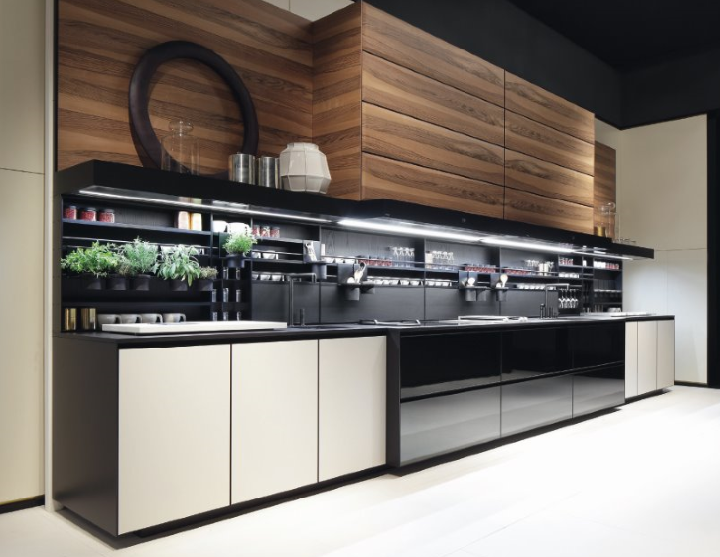
Quick reference table — the data behind every decision below
| Material | What it is | 18mm price/sq ft (Apr 2026) | Termite resistance | Direct water resistance | Best use |
|---|---|---|---|---|---|
| HDHMR | High-density wood fibre densified with phenolic resin | ₹90-110 plain · ₹105-160 laminated | Excellent (pre-treated core) | Good (humidity, steam) | Most kitchen cabinets, drawers, shutters |
| BWP Plywood (general) | Veneer plies bonded with phenolic adhesive | ₹130-160 | Moderate (needs treatment) | Excellent (immersion-rated) | Under-sink, dishwasher zone, coastal humidity |
| BWP IS:710 Marine | BWP plywood certified to IS:710 BIS standard | ₹150-190 | Moderate (needs treatment) | Excellent (72-hour boil tested) | Coastal cities, prolonged-water-contact zones |
| Pre-laminated particle board (PLPB) | Wood chips bonded with formaldehyde resin | ₹35-90 | Poor | Poor (swells in moisture) | Avoid in kitchens |
| MDF | Fine wood fibres bonded with formaldehyde resin | ₹50-130 | Poor | Poor unless waterproofed | Shutter face only — never carcass |
Prices exclude 18% GST. Verified from hdhmr.in, greenply.com, and Building and Interiors industry survey, April 2026.
What HDHMR actually is (most articles get this wrong)
HDHMR stands for High Density High Moisture Resistance. It’s not plywood. It’s not MDF either, though it shares MDF’s manufacturing principle.
HDHMR is made by:
- Wood fibre extracted from agricultural residue and softwood waste
- Combined with phenolic resin (the high-strength one — same family as in BWP plywood adhesive)
- Compressed under heat at significantly higher pressure than standard MDF — typically 750-850 kg/m³ density vs MDF’s 600-700
- Pre-treated during manufacture for borer/termite resistance
The result is a panel that’s:
- Denser and stiffer than MDF (so it holds screws indefinitely)
- Termite/borer resistant from the core (so termites don’t even nest in it)
- Moisture-resistant in ambient humidity (steam, splashes) — though not designed for direct water immersion
- Consistently flat (no plywood-style core voids or warpage)
- Easier to machine cleanly than plywood (better edge profiles, sharper cuts)
The major HDHMR brands in India are Action Tesa (the most established), Century Ply, and Greenply. Action Tesa pioneered the category in India and remains the price benchmark.
What BWP plywood actually is (and the IS:710 distinction)
BWP stands for Boiling Water Proof. It’s a plywood — multiple thin veneers of wood glued together with phenolic resin in alternating grain directions. The “boiling water proof” name is literal: the IS:710 certification process actually requires the bonded sample to survive 72 hours of submerged boiling without delamination.
The critical distinction most articles miss:
- BWP plywood (general): “Marine grade” claim, but no specific BIS certification. Quality varies wildly between manufacturers. Cheaper.
- BWP IS:710 plywood: Certified by the Bureau of Indian Standards against the IS 710:2010 specification. Tested to specific tensile-shear strength after the 72-hour boil cycle, plus mycological resistance, density tolerances, and moisture content limits. Premium tier.
If a vendor says “marine plywood”, ask whether it’s specifically IS:710 stamped. The price gap is roughly ₹15-30 per sq ft — but it’s the difference between “claimed” and “certified”.
Greenply’s Gold Marine 18mm BWP retails at ₹139/sq ft (April 2026, inclusive of GST per Greenply’s own published price chart). Century Ply, Kitply, and Sainik 710 are other established BWP IS:710 brands.
Direct head-to-head — the four questions that actually matter
1. Which is more moisture resistant?
This is the question most blogs answer wrong. The honest answer depends on what kind of moisture:
- Ambient kitchen humidity (steam from cooking, splashes from sink): Both HDHMR and BWP IS:710 perform equivalently in real installations. We’ve installed thousands of both and the failure rate from ambient moisture is statistically the same.
- Direct water exposure (under-sink, around dishwasher, behind washing machine): BWP IS:710 wins clearly. The 72-hour boil test isn’t a marketing gimmick — it reflects real worst-case wet exposure.
- Sustained high humidity (coastal cities — Mumbai, Chennai, Goa): BWP IS:710 has a moderate edge. HDHMR is fine but ages slightly faster in 80%+ ambient humidity year-round.
In our spec sheets, we use HDHMR for the upper cabinets, base cabinets, and tall units. We use BWP IS:710 specifically for: under-sink cabinet bottom panel, dishwasher cavity, and any cabinet floor that’s directly under a water inlet.
2. Which is better for termite resistance?
HDHMR wins this clearly. Quality HDHMR boards (Action Tesa, Century, Greenply) come pre-treated for termite/borer resistance during manufacture. The chemical treatment is integral to the board core.
BWP plywood — even IS:710 grade — is NOT termite-proof unless explicitly stamped as such. Most BWP isn’t. Termite-proof BWP exists (Greenply 710 Termite-Proof, Century Sainik 710 Termite-Proof) but adds 8-15% to the standard BWP price.
For Indian conditions (especially Northern India where termite activity is high), termite-proofing isn’t optional — it’s table stakes. This is the strongest single argument for HDHMR over standard BWP for cabinet carcass.
3. Which holds up structurally over time?
Long-term structural performance comes down to two things: screw retention and warpage resistance.
- Screw retention: HDHMR holds screws better than MDF and slightly better than standard BWP plywood (HDHMR’s density and homogeneous fibre matrix outperform plywood’s veneer layers when a screw cycles in and out repeatedly). Real-world: hinges and drawer slides on HDHMR cabinets stay tight 10+ years; on plywood they may need a re-tightening at the 5-7 year mark.
- Warpage: HDHMR is inherently flatter than plywood — no veneer-grain stress, no glue-line variation. A 2400×1200mm HDHMR sheet typically holds tolerance within 1mm; equivalent BWP plywood can be 2-4mm out. For tall pantry doors and full-height cabinets where flatness matters visually, HDHMR has a clear edge.
4. Which is easier to work with for clean machining?
HDHMR cuts cleaner. Edges are crisper. CNC routing produces consistent profiles. Plywood — even premium BWP — has slight veneer-edge feathering that requires more sanding.
For mass production this matters because it affects edge-banding adhesion. Cleaner edges = better edge band seal = longer cabinet life. We’ve measured a meaningful reduction in edge-band peeling complaints since switching the bulk of our cabinets to HDHMR.

The hybrid approach — what we actually spec for our customers
Most kitchens we deliver use a deliberate mix:
| Cabinet location | Carcass material | Why |
|---|---|---|
| Standard upper cabinets | 18mm HDHMR | Termite-resistant, screw-holding, flat. Most of the kitchen. |
| Standard base cabinets | 18mm HDHMR | Same reasoning. ~70% of total carcass material. |
| Tall pantry units | 18mm HDHMR | Flatness matters most for tall doors; HDHMR wins. |
| Under-sink base cabinet (bottom panel) | 18mm BWP IS:710 | Direct water exposure if a leak happens. Marine-grade is non-negotiable here. |
| Dishwasher cavity (side + back) | 18mm BWP IS:710 | Same — leak risk + sustained humidity from dishwasher cycle. |
| Under-water-purifier cabinet | 18mm BWP IS:710 | RO units leak. Plan accordingly. |
| Behind washing machine (if part of kitchen run) | 18mm BWP IS:710 | Sustained moisture + occasional spray. |
| Mumbai/Chennai/coastal-city kitchens (entire carcass) | 18mm BWP IS:710 throughout | Sustained 80%+ humidity erodes any wood-fibre panel faster than mainland India. Marine-grade BWP everywhere. |
| Shutter face material | 18mm HDHMR (with finish) | Flatness is critical for shutters. HDHMR holds finish better than plywood. |
For an average 8×10 ft Delhi-NCR kitchen, this hybrid uses roughly:
- HDHMR: ~90-110 sq ft (cabinets + shutters)
- BWP IS:710: ~10-15 sq ft (wet zones)
Cost impact vs all-HDHMR: roughly +₹600-900 total. Cost impact vs all-BWP: roughly -₹3,000 to -₹4,500. The hybrid gives you marine-grade protection where you actually need it without paying marine-grade prices for the entire kitchen.
What about MDF and pre-laminated particle board?
Quick guidance:
- Pre-laminated particle board (PLPB): Avoid for kitchens. Period. The wood-chip core absorbs moisture rapidly — even ambient humidity in summer makes it swell. Standard kitchen lifespan is 4-7 years before noticeable degradation. The cost saving of ₹6,000-15,000 per kitchen is not worth a 10-year-shorter cabinet life.
- Standard MDF: Acceptable as a shutter face material (where it’s sealed and never gets wet) but not as a kitchen carcass. Forest Plywood’s analysis of moisture-resistant MDF confirms standard MDF disintegrates under sustained kitchen humidity within 3-5 years.
- Moisture-resistant MDF (MR-MDF): Better than standard MDF, but still inferior to BWP/HDHMR for carcass. Reasonable for shutter face on budget builds. Don’t use for cabinet body.
Common vendor games to watch for
Three patterns we see in the market that quietly inflate costs or reduce quality:
“Marine ply” without IS:710 stamp
Many vendors quote “marine plywood” or “BWP marine grade” without specifying IS:710 BIS certification. The board may be genuinely waterproof — or it may be standard BWP rebranded. Always ask: “Is this stamped IS:710?” If they don’t know or change the subject, the answer is no.
HDHMR for the whole kitchen at BWP IS:710 prices
Some vendors quote HDHMR throughout (cheaper for them to source) but charge marine-grade prices. The customer gets a perfectly good HDHMR kitchen but pays the premium they thought was buying marine ply for wet zones. Transparent itemised quoting per cabinet location prevents this.
Generic “termite-proof” claims
“Termite-proof” without manufacturer documentation is meaningless. Real termite-proof materials carry brand-specific stamps (Action Tesa BSR Termite-Proof, Century Sainik Termite-Proof, Greenply Termite-Proof). If the vendor can’t show you the stamp, they’re either guessing or marketing.
Quick decision framework
If you only remember three rules:
- HDHMR is the right default for most Indian kitchens. Termite-resistant, flat, screw-holding, ₹90-110/sq ft. ~70% of cabinets in our average kitchen.
- BWP IS:710 is non-negotiable for wet zones. Under-sink, dishwasher, water-purifier, washing-machine cavity. Pay the ₹150-190/sq ft for these specific cabinets — you’ll save ₹50,000+ in eventual repair if a leak happens.
- For coastal-city kitchens, go all-BWP IS:710. Mumbai, Chennai, Goa, Vishakapatnam — sustained 80%+ humidity erodes any wood-fibre panel faster. Marine-grade everywhere is the right call for those climates.
For full context on common kitchen-buying mistakes (including how vendor games compound this material choice), see our 5 Modular Kitchen Mistakes That Cost Lakhs article.
Want this spec’d for your specific kitchen?
If you’re planning a modular kitchen for a Delhi NCR, Mumbai, or Bangalore home, we’ll send you a free written spec sheet listing the exact carcass material per cabinet location, brand+model of every component, and total transparent pricing — same format you can use to compare any other vendor on identical terms. Book a free design consultation with our team and we’ll walk through your specific cabinet-by-cabinet plan in 30 minutes.
No fluff. No upsell. Just an honest hybrid spec for your kitchen.
— The WideConcepts team. Manufacturing luxury furniture in Delhi NCR since 2014.
Sources and further reading
All pricing data and standards in this article are sourced from publicly available industry references as of April 2026. We recommend verifying current prices directly with vendors before final purchase.
- HDHMR Board Price List India 2026 — hdhmr.in
- HDHMR vs Marine Plywood (BWP) comparison — hdhmr.in
- Plywood Price in India 2026 — Greenply
- Bureau of Indian Standards IS 710 Product Manual
- IS 710:2010 Marine Plywood Specification (PDF)
- Cost of plywood per sq ft in India — Building and Interiors
- Moisture-Resistant MDF — Forest Plywood
- 7 Benefits of HDHMR Over Traditional Plywood — WideConcepts (companion piece)
Disclaimer: All prices are indicative ranges based on April 2026 published market data. Actual prices vary by region, dealer, brand finish, and current market conditions. GST (18%) is excluded from quoted board prices unless otherwise stated.
